

At ai71, we believe AI should solve the world's hardest problems, not just the most profitable ones. In December 2025 in Abu Dhabi, we took a massive step toward that vision with the launch of the AI Hub for Agriculture and our flagship project, AgriLLM.
Working with visionaries like Bill Gates and partners from the International Affairs Office at the UAE Presidential Court, CGIAR, EMBRAPA, the Gates Foundation, the World Bank, the FAO, ECHO and a global network of collaborators, we are bringing AgriLLM to life - a collection of open-source AI building blocks and tools designed to help the agriculture community bridge critical information gaps. On top of this foundation, we are also developing an intelligent assistant for the unsung heroes of our global food system: smallholder farmers.
Here is why this work matters, what we’ve built, and why we need you to help us break the language barrier.
1. The Problem: A Crisis of Access
Smallholder farmers produce a third of the world’s food, yet they are on the frontlines of a climate crisis they did not create. The "big problem" isn't just weather - it’s information inequality.
- The Knowledge Gap: Millions of farmers lack access to timely advice on planting cycles, pest control, or drought resistance.
- The Climate Reality: Traditional farming wisdom is becoming less reliable as weather patterns shift unpredictably.
- The Stakes: When these farmers fail, it doesn’t just mean lost income; it means hunger for their families and instability for the global food supply chain.
2. How the World Tackles it Today
Currently, agricultural support relies heavily on human extension services - experts who physically travel from farm to farm.
- The Bottleneck: There are simply not enough experts. In many countries, the ratio is one extension worker for every 3,000+ farmers.
- The Speed: By the time an expert visits to diagnose a crop disease, the harvest might already be lost.
- The Disconnect: Digital tools exist, but they are often text-heavy, require expensive data plans, or fail to speak the farmer’s native dialect.
3. What We Have Done So Far
What if every farmer could tap into the expertise of a world-class agronomist, whenever they needed it, in their own language?
That’s the vision AgriLLM makes possible.
To build this, we didn’t just scrape the internet. We partnered with CGIAR, the world’s largest agricultural research network, Embrapa, Brazil’s leading agricultural research organization, ECHO, and many other top institutions to train our model on decades of high-quality, scientific agricultural data.
- Why It’s Critical: Unlike generic AI models that often give broad, generic answers, hallucinate facts, or struggle to reason with agricultural context, AgriLLM is grounded in real-world agricultural knowledge. It’s built to be more accurate and contextual - all fully open-source.
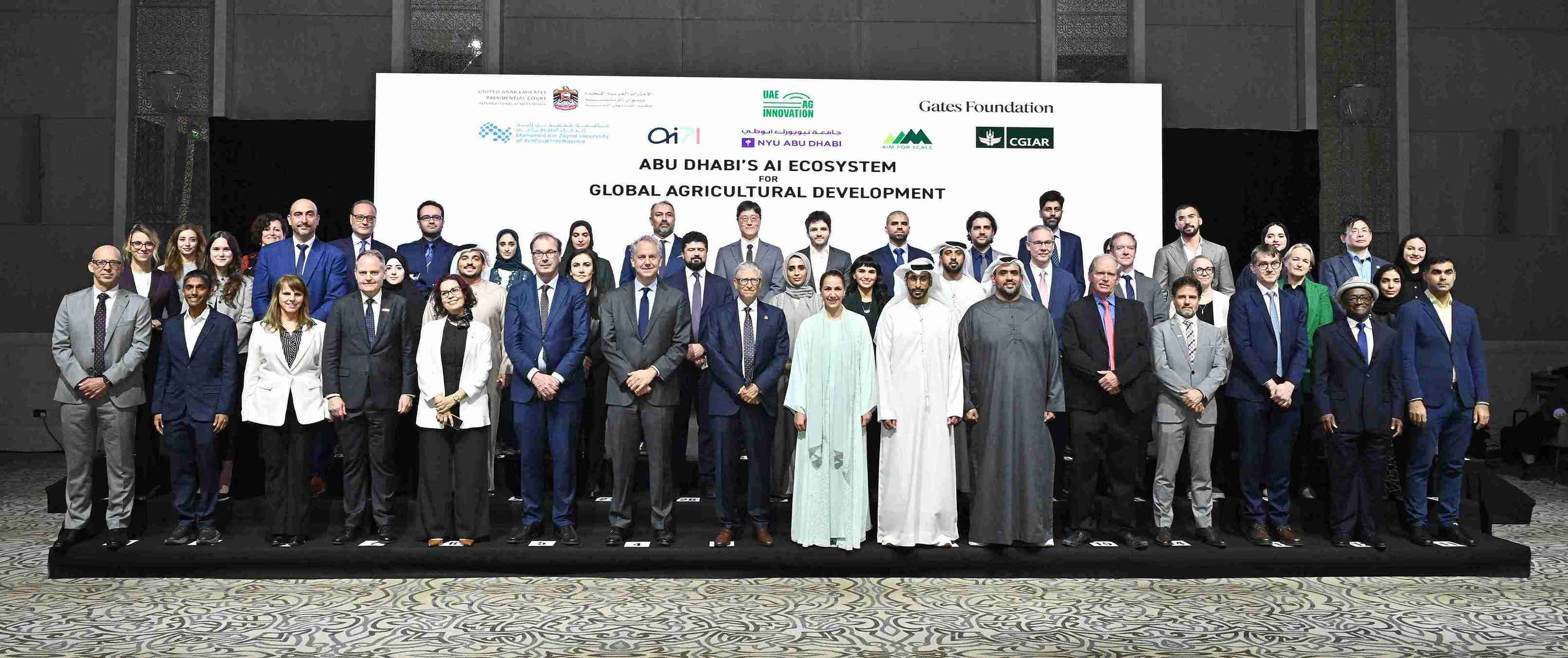
- The Launch: At the recent unveiling in Abu Dhabi, alongside Bill Gates and H.E. Mariam bint Mohammed Almheiri, we showcased that AgriLLM is more than a concept. It’s a foundation designed to empower farmers and extension agents, providing them with the intelligence to bridge the gap between high-level agricultural research and on-the-ground decision-making.
4. The Language Challenge: A Call for Researchers
This is where the next frontier lies. A text-based chatbot is useless to a farmer who cannot read or who speaks a dialect not covered by major tech platforms.
We are on a mission to build world-class audio capabilities for rare and under-resourced languages.
We don't just need "French"; we need the specific rural dialects of West Africa. We don't just need "Hindi"; we need the nuances of rural dialects across Indian states.
An Invitation to Researchers & Linguists:
We are actively seeking partnerships with computational linguists, acoustic model researchers, and universities working on low-resource languages. If you are building speech-to-text or text-to-speech models for languages that Big Tech often ignores, we want to work with you. Let’s work together to integrate your research into AgriLLM to give millions of farmers a voice.
5. What is to Come Next
The launch was just Day One. Our roadmap includes:
- Pilot Testing: Starting to work with our partners in key countries to test AgriLLM’s models and tools in real-world contexts, gather feedback, and iterate for practical impact.
- Multimodal "See & Solve": Expanding the AgriLLM suite with multi-modal open-source building blocks including dedicated computer vision modules - enabling applications where, for example, farmers can snap a photo of a diseased leaf and receive an instant audio diagnosis.
- Agentic Capabilities: Extending AgriLLM models to operate effectively in agentic contexts, leveraging information from weather services, soil data, satellites, and other sources - unlocking use cases where the model can integrate multiple data sources to provide actionable guidance to farmers, such as adjusting irrigation or preparing fields ahead of changing conditions.
- Reasoning Models: Extending AgriLLM with specialized reasoning-focused models, trained to truly understand the hidden intent behind farmers’ complex questions, navigate ambiguity, and break down challenges into clear, actionable steps.
6. What We Need to 10x the Impact
Building the model is only half the battle. To scale from thousands of users to the 100 million farmers targeted by the "AIM for Scale" initiative, we need a collective effort:
- Infrastructure: Governments and telcos must improve last-mile connectivity.
- Data Sovereignty: We need localized data sets to train our models on specific regional micro-climates.
- The "Audio" Coalition: As mentioned, we need the research community to help us crack the code on rare language processing.
The Bottom Line:
AgriLLM is more than code; it’s a commitment. By open-sourcing this technology, we are inviting the world to build with us. We are not just predicting the future of farming; we are helping to grow it.